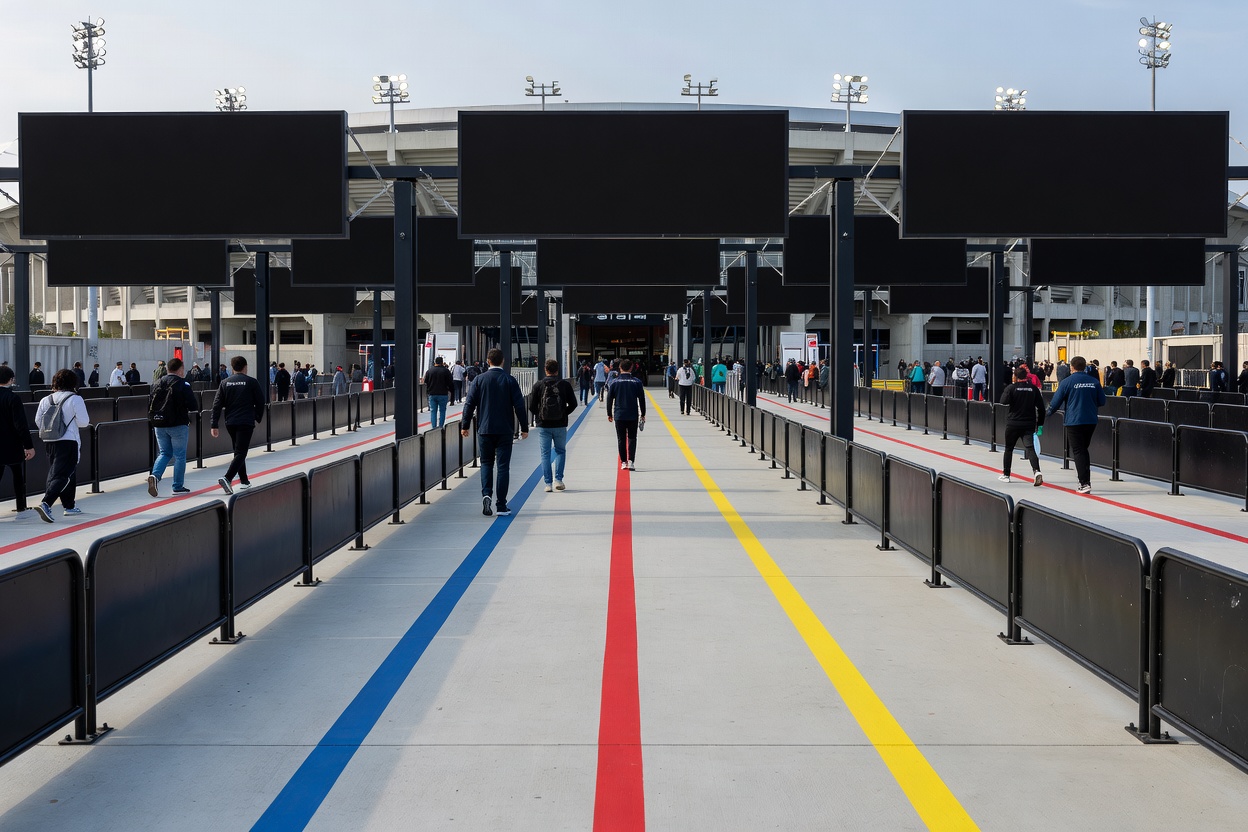
Plan the arrival condition
Start with the event profile: opening time, expected arrival pattern, ticket or credential types, transport approaches, weather exposure and the venue’s accessible routes. Entry design should support safe movement before a queue forms, not only after pressure appears.
Separate activities that need different speeds. Ticket or credential verification, screening, bag checks and final admission should have clear relationships. Keep staff positions visible and avoid placing an information point where it interrupts the main lane.
Entry lane design
- Set lane widths and barriers according to venue capacity, accessibility needs and local requirements.
- Use queue geometry that allows staff to see the next decision point and visitors to understand where to go.
- Keep emergency routes and service movement separate from public queues.
- Provide a managed response for rejected, unclear or damaged credentials.
- Review lighting, weather cover, flooring and communication coverage at each lane.
Screening zones
Screening areas need enough space for the process, private resolution of exceptions and safe staff movement. Define where bags are presented, where questions are answered and where an item or credential issue is referred. Procedures should be lawful, proportionate and aligned with venue policy and local requirements.
Do not publish sensitive operational details that could compromise screening. Brief staff through controlled documents and update them when the event plan changes.
Staff positioning
Position staff at transitions: queue approach, verification, screening, accessible entry, information points and internal dispersal. Assign a supervisor who can adjust lane use without creating conflicting instructions. Use plain signage so staff do not need to repeat basic directions for every visitor.
Peak arrival periods
Model the first arrivals, the main arrival wave and late arrivals separately. Note where queues could affect public roads, transport interfaces, hospitality areas or emergency access. Define triggers for opening an additional lane or changing the staff position. These triggers should be observable and agreed at briefing.
Accessibility and wayfinding
Accessible entry must be equivalent in dignity, information and security. Provide clear routes for wheelchair users, people with mobility needs, families and visitors who need assistance. Use high-contrast signs, consistent symbols and staff who know the route.
Good for
High-attendance events, venues with mixed ticket types, temporary screening layouts and sites where queues affect surrounding public space.
What to know
Queue control is a combined design and staffing task. Barriers alone do not create a safe flow.